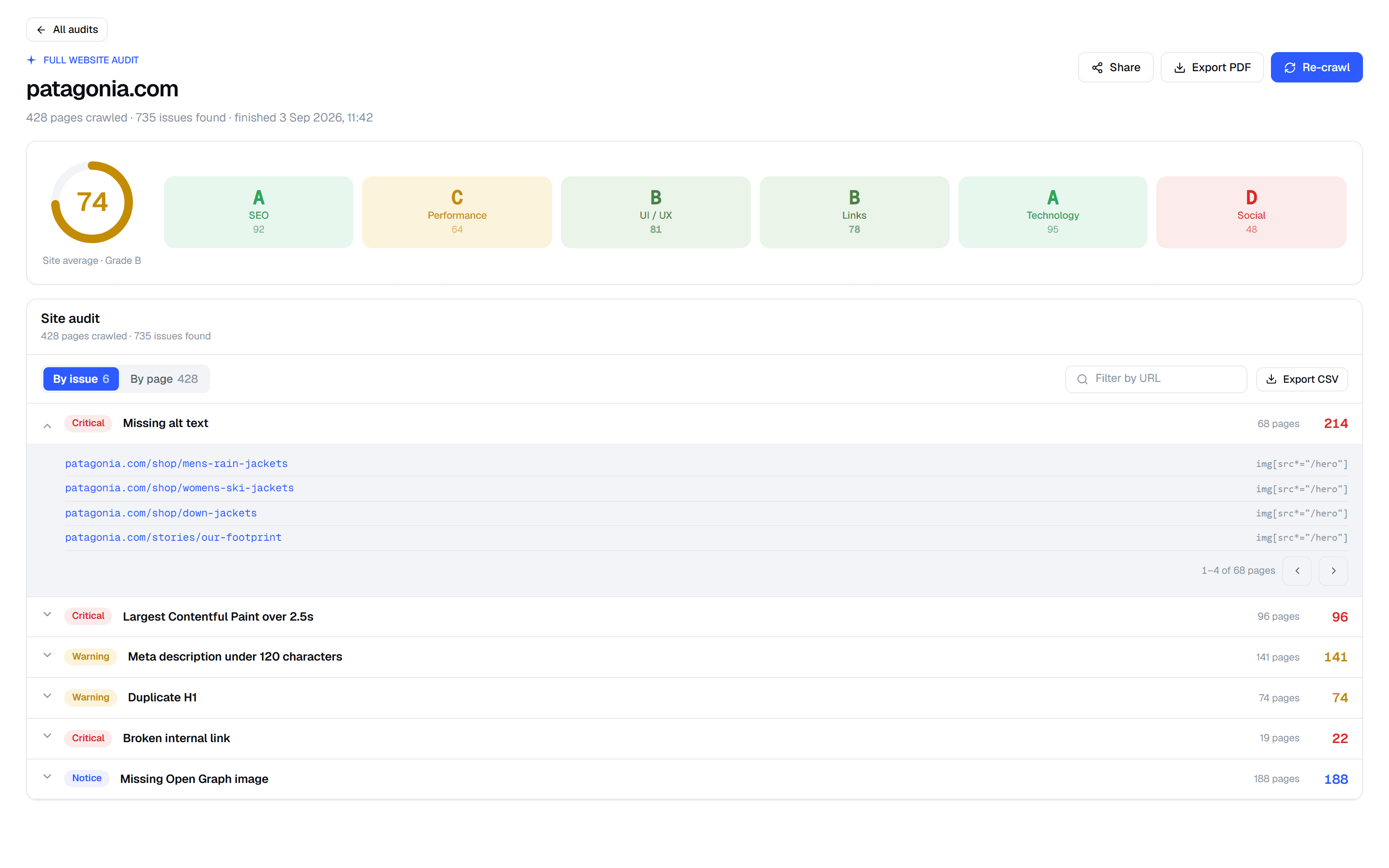
What does a website SEO audit check?
Everything that stops search engines finding, reading and trusting your pages: crawlability (robots.txt, sitemap, canonical and noindex tags), security (HTTPS), on-page elements on every URL, performance, mobile usability, links, structured data and social tags. Each finding lists the pages it affects.
Which issues should I fix first?
Start with Critical findings, and with anything that keeps pages out of the index — a robots.txt block, a stray noindex, a wrong canonical. Next, fix issues that repeat across many pages, since one template change often clears hundreds of URLs. Lower-severity notices can wait for a routine pass.
Does it check robots.txt and my XML sitemap?
Yes. The audit reads your robots.txt, flags pages its rules block, and looks for an XML sitemap — the two files that tell search engines what they may crawl and what you want indexed.
Does it find thin content?
Every page's word count is checked, so thin pages stand out. To spot content that is decaying — pages losing clicks over time — connect Search Console and compare date ranges in its Pages table.
Does the audit cover internal links and click depth?
The Links grade looks at each page's balance of internal and external links. For the whole link graph — click depth from the homepage, hub pages and orphan pages — run Internal Link Analysis on the same domain.
How is a site audit different from a page audit?
A site audit crawls the whole domain and shows which problems are widespread. A page audit scores one URL in depth and explains every check — use it on the pages that matter most once the site-wide issues are fixed.
How often should I audit my site?
After any launch, redesign or migration, and on a regular schedule — monthly for sites that publish often, quarterly for quieter ones. Re-crawl whenever you like to confirm fixes have landed.
How many pages can one audit crawl?
Up to 1,000 pages in a single crawl.
How much does a website audit cost?
5 credits per page crawled, so a 100-page crawl costs 500 credits.
Can I share the report?
Yes. Share the report as a link, or export it to PDF or CSV.
Is there a free plan?
Yes. The free plan covers Google rank tracking with 100 credits every month, refilled automatically, with no credit card. Every other tool comes with any paid plan, from $19/month for 2,000 credits, or any credit pack.
Do I need a separate subscription for this tool?
No. Every FreeSERP tool draws from the same credit balance. The free plan's credits cover Google rank tracking; everything else — the SERP checker, site audits, competitor analysis, keyword research, the keyword score checker, internal link analysis, AEO & GEO audits and Google Maps audits — needs a paid plan or a credit pack.