The page you actually care about, scored end to end and explained in words you can act on. Six category grades sit under one overall score, and every failed check says what it found, why it matters and where. When the audit is done you can ask it a follow-up question.
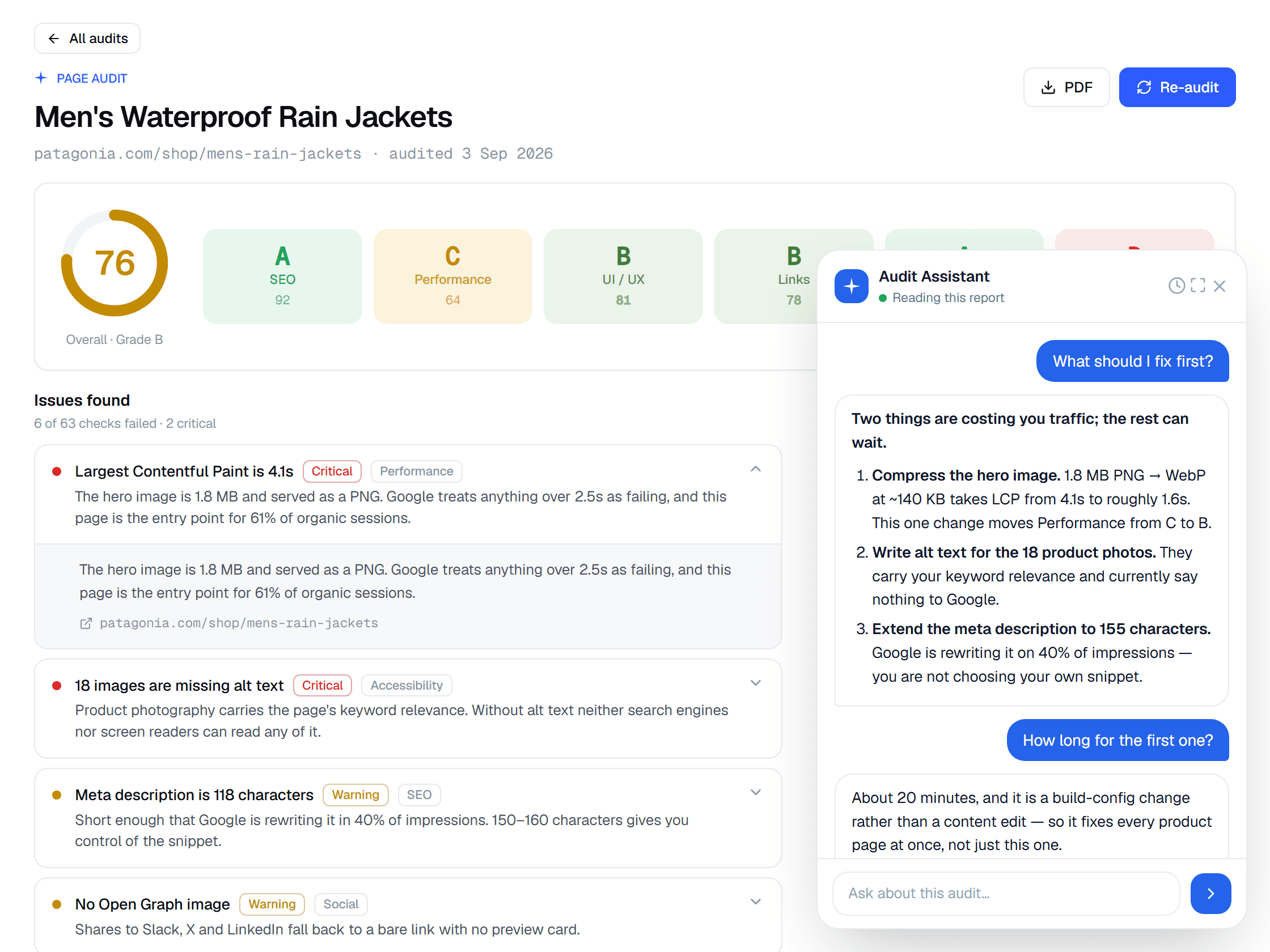
An interactive example of the results screen. Click, toggle and drag — it works like the real tool.
Mobile-first indexing means Google primarily uses the mobile version of your site for ranking. A poor mobile score directly impacts rankings and frustrates the majority of users who browse on mobile.
Focus on improving Core Web Vitals (LCP, INP, CLS), optimize images for mobile, minimize JavaScript, use responsive design, and leverage browser caching. Review the specific recommendations in PageSpeed Insights.
Open the full website audit report — the same scores, sections and checks you'll get for your own site, filled with example data.
Example data — opens in a new tab. Use “Download PDF” inside to save it as a PDF.
The one page you actually care about — a landing page, a product page, a post you want to rank.
Graded across six categories, under one overall score.
Every failed check says what it found and why it matters — and you can ask the finished audit what to fix first.
Everything on a single page that affects how it ranks and gets clicked: the title tag, meta description and URL that make up its search snippet, the H1 and heading structure, keyword use across title, headings and copy, image alt text, word count, canonical and indexing tags, structured data, mobile usability and page speed.
The audit looks for a title of 40–60 characters and a meta description of 70–160 — long enough to say what the page is about, short enough not to be cut off in results. Put the main keyword early and write each one for the person deciding whether to click.
Yes. It looks for identity schema (Organization or Person) and, for local businesses, LocalBusiness schema, along with the Open Graph and Twitter card tags that control how the page looks when shared.
The audit measures how much of your content is in the page's initial HTML rather than added later by JavaScript. Many AI crawlers read only that first HTML, so content they cannot see cannot be quoted.
Page Audit scores one URL in depth against 63 checks and explains each one. Site Audit crawls up to 1,000 pages and reports which issues repeat across the whole site. Run the site audit to find patterns, and the page audit on the pages that earn money.
Yes. Once the audit is done, the Audit Assistant answers follow-up questions such as what to fix first.
Yes. The free plan covers Google rank tracking with 100 credits every month, refilled automatically, with no credit card. Every other tool comes with any paid plan, from $19/month for 2,000 credits, or any credit pack.
No. Every FreeSERP tool draws from the same credit balance. The free plan's credits cover Google rank tracking; everything else — the SERP checker, site audits, competitor analysis, keyword research, the keyword score checker, internal link analysis, AEO & GEO audits and Google Maps audits — needs a paid plan or a credit pack.
100 free credits every month for real-time Google rank tracking — for SEOs, marketers, and developers. Plans from $19/month add competitor intelligence and every other tool, paid for out of one balance.
Start Tracking for Free →